
Examples of workplace upskilling that advance careers
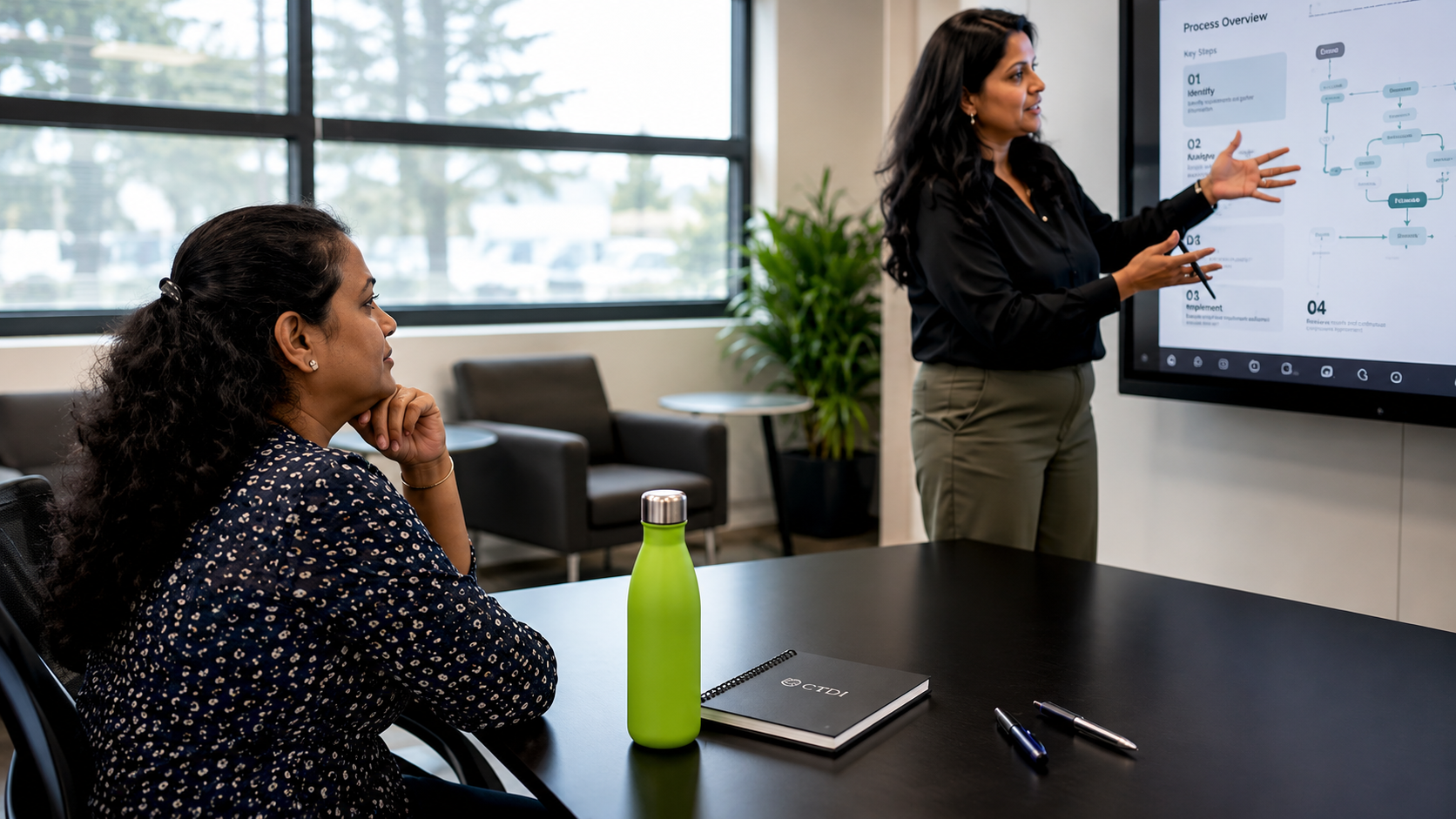
Workplace upskilling involves deliberately enhancing employees' skills to meet new demands and foster career growth.
Successful programmes link learning directly to daily work, utilizing methods like role-based platforms, social learning, and cohort projects.
Workplace upskilling is defined as the deliberate process of enhancing employees' existing skills to meet new professional demands, close capability gaps, and drive career progression. It differs from reskilling, which trains people for entirely new roles. The most compelling examples of workplace upskilling today come from organisations like S&P Global, FedEx, and PwC, each of which has built structured programmes that produced measurable results. For professionals, understanding these methods is the fastest way to identify which approach fits your career goals and how to pursue it with confidence.
Examples of workplace upskilling methods that actually work
The most effective employee upskilling programmes share one trait: they connect learning directly to the work people do every day. Abstract training that sits outside daily tasks rarely sticks. The examples below represent the full spectrum of workplace skill development, from large-scale corporate initiatives to methods any individual professional can adopt.
1. Role-based personalised training platforms
FedEx built one of the most ambitious AI literacy programmes in corporate history, engaging over 440,000 employees globally through its LearnVantage platform. The programme delivers role-targeted courses, meaning a frontline warehouse worker receives different content from a logistics analyst or a finance manager. This specificity matters because generic training produces generic results.

Role-based platforms work because they reduce the cognitive load of deciding what to learn. Employees follow a curated pathway relevant to their actual job, which increases completion rates and practical application. For professionals without access to a corporate platform, tools like LinkedIn Learning and Coursera allow you to filter content by job function and skill level, replicating this personalised structure independently.
2. Social collaborative learning and prompting parties
PwC introduced a format called "prompting parties," where groups of employees gather to experiment with AI tools together, share discoveries, and solve real work problems in real time. The result was a 20 to 30% efficiency improvement across participating teams, with over 500 of these sessions held globally. The format works because it links skills to immediate daily tasks rather than abstract exercises.
Social learning removes the isolation that kills motivation in self-directed programmes. When colleagues learn together, they hold each other accountable, share shortcuts, and build confidence collectively. Any team can replicate this format by scheduling a 60-minute session where members bring a real work challenge and experiment with a tool together, no facilitator required.
Pro Tip:Schedule a monthly "skills session" with two or three colleagues where each person brings one work problem they want to solve with a new tool or method. This mirrors PwC's prompting party format at zero cost.
3. Cohort-based project learning
PwC also runs 90-day AI upskilling projects where cohorts of employees apply new skills to live business problems. This format combines formal instruction with immediate application, which is the most effective sequence for adult learners. Participants leave with a completed project, a demonstrated capability, and a peer network.
Cohort-based learning suits professionals who need accountability and structure. The fixed timeline creates urgency, and the shared goal builds momentum. If your organisation does not offer this format, professional associations and industry bodies in Australia frequently run cohort programmes in areas like project management, digital marketing, and data analysis.
4. AI-powered adaptive learning platforms
Adaptive learning platforms personalise content delivery based on a learner's pace and demonstrated strengths, accelerating progression for high performers while providing supplemental exercises for those who need reinforcement. This is a significant improvement over one-size-fits-all e-learning modules that bore strong learners and overwhelm weaker ones.
PwC's internal tool ChatPwC and Microsoft's Copilot integration into daily workflows are examples of AI tools that teach through use. Every interaction becomes a micro-learning moment. For individual professionals, experimenting with AI tools in your actual job, rather than in a sandboxed training environment, produces faster and more durable skill gains.
5. S&P Global's Spark AI Academy model
S&P Global's Spark AI Academy is one of the clearest examples of how to build employee upskilling programmes at scale. After launching targeted AI training for 40,000 employees, the organisation achieved a 400% increase in daily generative AI tool usage, 100% foundational training completion, and a net promoter score of +52. These numbers reflect genuine behavioural change, not just course completions.
The Spark Academy combined formal instruction, social learning, and on-the-job application, which maps directly to the 70-20-10 model discussed later in this article. The C-suite participated visibly, which signalled that learning was a strategic priority rather than an HR obligation. That leadership signal is often the difference between a programme that transforms a workforce and one that fades after the launch event.
6. Internal communities of practice and hackathons
Communities of practice are groups of employees who share a professional interest and meet regularly to exchange knowledge, solve problems, and develop shared resources. FedEx embedded these communities into its AI literacy programme to sustain learning beyond initial training. Hackathons serve a similar purpose by creating time-boxed challenges where cross-functional teams build solutions using newly acquired skills.
Both formats generate tacit knowledge transfer, the kind of know-how that cannot be captured in a course module. A data analyst who explains their workflow to a marketing colleague during a hackathon teaches something no formal curriculum covers. For professionals, joining or starting an internal community of practice is one of the highest-return upskilling activities available, and it costs nothing but time.
7. Mentorship and peer learning circles
Structured mentorship and peer learning communities facilitate knowledge transfer and leadership development in ways formal training cannot replicate. A mentor provides context, career perspective, and access to networks. A peer learning circle provides psychological safety, shared struggle, and collective problem-solving.
Leadership skills, in particular, develop through mentorship rather than coursework. If you are aiming for a management role, a formal mentorship arrangement with a senior leader in your organisation will accelerate your progression more than any online certificate. Peer circles work best for technical skills where members can review each other's work, share resources, and hold each other accountable to practice goals.
8. Prompt engineering and workflow automation for non-technical staff
One of the most practical upskilling examples emerging in 2026 is prompt engineering, sometimes called "vibe coding," which enables non-technical employees to automate workflows and build AI tools without traditional programming knowledge. A marketing coordinator who learns to write effective prompts for content generation, data summarisation, or customer research gains a capability that directly affects their output and visibility.
This form of skills enhancement in the workplace requires no formal qualification. Free resources from OpenAI, Google, and Anthropic provide structured prompt engineering guides. The skill is transferable across roles and industries, which makes it one of the most career-resilient investments a professional can make right now.
How the 70-20-10 model optimises upskilling cycles
The 70-20-10 learning model distributes learning across three sources: 70% from on-the-job experience, 20% from social and peer interaction, and 10% from formal training. Most organisations invert this ratio, spending the majority of their learning budget on formal courses that account for only 10% of actual skill development. Correcting this imbalance is the single most impactful structural change any upskilling programme can make.
Short learning cycles of two to four weeks improve retention and maintain motivation. When a learning sprint is too long, professionals lose momentum and revert to existing habits. When it is too short, there is insufficient time to apply new skills in a real context. The two to four week window hits the sweet spot: long enough for meaningful practice, short enough to feel achievable.
The practical application of this model looks like this:
70% experiential: Take on a stretch assignment, volunteer for a project outside your current scope, or apply a new tool to an existing task.
20% social: Join a community of practice, find a peer accountability partner, or participate in a team skills session.
10% formal: Complete a targeted course, attend a webinar, or earn a micro-credential in a specific skill area.
PwC's prompting parties are a direct expression of the social 20%, and the efficiency gains they produced demonstrate that this component is not optional. Social learning is where skills become habits.
Pro Tip:Map your current week against the 70-20-10 model. If you are spending more than two hours on formal learning for every hour of applied practice, rebalance. Swap one online module for a real task that uses the same skill.
Common challenges in implementing workplace upskilling
The biggest barriers to upskilling are not technological. Human-centric obstacles such as habit persistence and time availability are more significant than any platform limitation. Employees default to familiar workflows under pressure, and learning feels like an addition to an already full workload rather than part of the job itself.
Leadership involvement is the most reliable solution to both barriers. When C-suite leaders at S&P Global participated visibly in the Spark AI Academy, it communicated that learning time was protected and valued. Without that signal, employees treat training as optional and deprioritise it when deadlines arrive.
Several practical strategies address these challenges directly:
Embed learning in workflows: Replace a standalone training module with a job aid that appears at the moment of need, such as a prompt template in a shared document or a checklist embedded in a project management tool.
Protect learning time: Schedule upskilling as a recurring calendar block, not an aspiration. Canva's AI Discovery Week succeeded because time was formally allocated, not left to individual discretion.
Measure capability, not completion: Tracking AI Quotient or skill application rather than pass/fail rates gives employees a meaningful progress signal and gives organisations data to inform investment decisions.
Use simulation-based assessment:Simulation-based assessments provide richer capability data than knowledge tests, identifying real skill gaps rather than measuring memorisation.
"Psychological safety and social collaboration are not soft extras in an upskilling programme. They are the mechanism through which employees build confidence collectively and overcome the resistance that kills most training initiatives." — PwC CLO on social learning
Skills acquired in training must be applied within three to six months to become durable. If your organisation runs a training programme with no follow-through plan, the investment is largely wasted. Build application checkpoints into the programme design from the start.
Comparing upskilling methods for different career goals
Not every upskilling method suits every professional or every objective. The table below compares the four primary approaches by format, best use case, cost, and adaptability to remote or hybrid work.
| Point | Details |
|---|---|
| Social learning drives results | PwC’s prompting parties produced 20 to 30% efficiency gains by linking skills to real daily tasks. |
| Scale requires role-based design | FedEx trained 440,000 employees by tailoring content to specific roles, not delivering generic modules. |
| The 70-20-10 model rebalances effort | Seventy percent of skill development comes from experience, not formal courses. |
| Leadership sponsorship is non-negotiable | S&P Global’s C-suite participation drove 400% growth in daily AI tool usage across 40,000 employees. |
| Measure application, not completion | Tracking skill use and AI Quotient provides better data than pass/fail course records. |
Formal education suits professionals who need a recognised credential for a career transition or promotion. An online AI diploma or a digital marketing qualification provides structured, accredited learning that carries weight with employers. On-the-job learning is the most cost-effective method for developing leadership and project skills, but it requires a supportive manager and deliberate stretch assignments.
Social and collaborative formats scale well in remote environments because they require only a video call and a shared agenda. AI-powered platforms are the most scalable option for large organisations because they adapt to each learner without requiring additional facilitators. For most professionals, the highest-return strategy combines all four: a formal credential for credibility, experiential practice for depth, social learning for motivation, and an adaptive platform for efficiency.
Key takeaways
Effective workplace upskilling combines formal credentials, on-the-job practice, social learning, and adaptive technology to produce durable, career-relevant skills.
| Point | Details |
|---|---|
| Social learning drives results | PwC’s prompting parties produced 20 to 30% efficiency gains by linking skills to real daily tasks. |
| Scale requires role-based design | FedEx trained 440,000 employees by tailoring content to specific roles, not delivering generic modules. |
| The 70-20-10 model rebalances effort | Seventy percent of skill development comes from experience, not formal courses. |
| Leadership sponsorship is non-negotiable | S&P Global’s C-suite participation drove 400% growth in daily AI tool usage across 40,000 employees. |
| Measure application, not completion | Tracking skill use and AI Quotient provides better data than pass/fail course records. |
What I have learned from watching upskilling programmes succeed and fail
I have seen organisations invest heavily in learning management systems and produce almost no behavioural change. I have also seen a team of six people run a weekly 45-minute skills session with no budget and transform their collective capability within three months. The difference is never the platform. It is always the culture.
The programmes that work share one characteristic: learning feels like part of the job, not a tax on it. When PwC embedded prompting parties into the working week rather than scheduling them as after-hours development, participation rates reflected that respect for people's time. When S&P Global made AI literacy a visible C-suite priority, employees understood that their career progression was connected to it.
Short, focused learning bursts outperform long courses in almost every context I have observed. A professional who spends 20 minutes three times a week applying a new skill in their actual work will outpace someone who completes a 10-hour course and then returns to their existing habits. The career development strategies that compound over time are built from small, consistent actions, not periodic intensive events.
The uncomfortable truth about upskilling is that most resistance is not about time or technology. It is about psychological safety. People do not want to look incompetent in front of their colleagues. Social learning formats work precisely because they normalise not knowing. When everyone in the room is experimenting, no one is embarrassed to get it wrong. If you are building a programme or pursuing your own development, create the conditions where failure is expected and iteration is celebrated. That is where real learning happens.
For professionals in Australia navigating AI's impact on entry-level roles, upskilling is not optional. It is the primary mechanism for staying relevant and advancing. Start with the method that fits your current context, apply it consistently, and build from there.
— Sam
How Edu supports your upskilling goals
If the methods in this article have clarified what you want to learn next, Canterbury Training and Development Institute (CTDI) offers structured pathways to get you there.
CTDI's online diplomas in artificial intelligence, digital marketing, and sustainability are designed by industry experts and delivered entirely online, so you can build credentials around your existing work schedule. Courses are self-paced and nationally recognised, giving you the flexibility of independent learning with the credibility of accredited qualifications. Whether you are building AI literacy, transitioning into a new field, or strengthening your professional profile, enrol in a CTDI diploma and take the next step in your career with a qualification that employers recognise.
FAQ
What is workplace upskilling?
Workplace upskilling is the process of improving employees' existing skills to meet new job demands or advance within their careers. It differs from reskilling, which prepares people for entirely different roles.
What are the best examples of workplace upskilling programmes?
The most cited examples include S&P Global's Spark AI Academy, FedEx's LearnVantage role-based training, and PwC's prompting parties, each of which produced measurable efficiency and adoption gains at scale.
How do I implement an upskilling programme in my organisation?
Start by mapping current skill gaps against future role requirements, then apply the 70-20-10 model: 70% on-the-job practice, 20% social learning, and 10% formal training delivered in two to four week cycles.
How long does it take for upskilling to show results?
Skills acquired in training should be applied within three to six months to become durable. Programmes with no follow-through plan after the training event rarely produce lasting behavioural change.
Can individuals upskill without employer support?
Yes. Professionals can replicate corporate upskilling methods independently by using adaptive platforms like LinkedIn Learning, forming peer learning circles with colleagues, and pursuing accredited online qualifications through providers like CTDI.