
How to Start Digital Marketing Without a Degree in Australia

You do not necessarily need a university degree to start building a career in digital marketing. What matters is developing relevant skills, understanding how marketing works in practice and being able to demonstrate what you can do.
For career changers and people entering the industry, a strong pathway usually combines practical experience with structured learning. A portfolio can show how you apply your skills, while further study can help you build those skills systematically and understand the broader strategy behind them.
There is no guaranteed timeline for entering digital marketing. Your previous experience, available study time, chosen specialisation and the job market will all influence your progress. However, a six-to-nine-month development plan can give you enough structure to move from learning the fundamentals to building meaningful portfolio evidence.
Start with the foundations
During your first couple of months, focus on understanding the main areas of digital marketing before trying to specialise.
Build familiarity with digital strategy, customer journeys, content marketing, social media, SEO, email marketing, paid advertising and analytics. You do not need to master every platform at this stage. The goal is to understand how different channels contribute to a broader marketing objective.
This is also a good time to experiment with tools such as Google Analytics, Google Ads, email marketing platforms and basic reporting tools.
Once you understand the fundamentals, choose one or two areas to explore in more depth. You might focus on SEO, content, social media, paid media, email marketing or analytics.
Choosing a focus helps you move from passive learning to practical application.
Build experience before you have the job title
You do not need to wait for your first full-time marketing role before creating work you can discuss professionally.
A personal website, newsletter, social media strategy, campaign concept, volunteer project or small marketing experiment can all become portfolio material.
What matters is how you document the work.
For each project, explain:
what you were trying to achieve;
who the audience was;
what approach you used;
what happened;
what the data or feedback showed;
what you would improve next time.
A good portfolio should show how you think, not simply which tools you have used.
Even a project that did not perform as expected can demonstrate useful skills if you can explain what happened and how you would respond differently next time.
If you take part in unpaid work experience or an internship, remember that Australian workplace laws still apply. Whether an arrangement can legally be unpaid depends on the circumstances, so it is important to check current Fair Work guidance before accepting ongoing commercial work without pay.
Focus on transferable digital marketing skills
Digital marketing roles vary considerably, but several skill areas are useful across the industry.
Analytics helps you understand what happened, why it happened and what should happen next. Marketers increasingly need to interpret website traffic, conversions, engagement and campaign performance rather than simply report numbers. Content and communication remain important even as AI becomes more integrated into marketing workflows. Strong marketers still need to understand audiences, brand voice, positioning, customer intent and calls to action.SEO and search marketing help you understand how people discover information online and how businesses can improve visibility through both organic and paid channels. Social media marketing goes far beyond posting content. Strategic skills include audience research, content planning, paid social, campaign measurement and community management. AI literacy is also becoming increasingly relevant. Marketers need to understand how AI can support workflows while still applying human judgement to accuracy, brand consistency, ethics and decision-making.
CTDI’s Advanced Diploma of Digital Marketing includes study areas such as digital analytics, SEO, paid search, social media strategy, email marketing and responsible AI, helping learners build capability across several of these areas.
Free learning and formal study can work together
Free learning resources can be a useful starting point, particularly when you want to explore a platform or develop one specific skill, platform-based learning from providers such as Google, Meta and HubSpot can help you understand tools, terminology and basic workflows, formal study serves a different purpose.
A nationally recognised VET qualification involves structured learning and formal assessment against defined requirements. This can be useful for people who want to develop broader capability rather than learn one platform in isolation. The important question is not simply, “Which course is best?”
A better question is: What skills am I trying to build, and what kind of learning will help me build them?
For some people, self-directed learning may be enough for the next step. Others may benefit from a structured qualification, particularly when changing careers or developing more advanced strategic capability.
Choose tools based on the problem you need to solve
One common mistake is trying to learn every platform available, tools change quickly, core marketing principles are much more transferable.
Start by understanding the main categories:
analytics and reporting;
search;
CRM and email marketing;
advertising platforms;
content creation;
spreadsheets and data organisation.
Rather than focusing on saying “I know this tool”, aim to be able to say: “I understand this marketing problem and I know how to use the right tools to solve it.” That mindset is far more useful as platforms evolve.
Use your existing experience
Career changers often underestimate how much of their previous experience can transfer into marketing.
Someone from customer service may already understand customer needs and communication, someone from sales may understand buyer behaviour, objections and conversion, a designer may bring strong visual communication and brand awareness, someone from administration or operations may already have experience with reporting, coordination, systems and stakeholder communication.
Your previous career does not disappear when you move into marketing. The goal is to identify which skills transfer and which gaps you still need to fill, that makes your learning much more focused.
Where VET qualifications fit into the pathway
Short courses, professional certifications and nationally recognised VET qualifications serve different purposes, a certificate of completion usually confirms that you completed a learning activity or course, a nationally recognised VET qualification involves formal assessment against defined Australian training requirements.
For learners looking for a structured pathway, CTDI offers the 11266NAT Advanced Diploma of Digital Marketing, delivered fully online and self-paced.
The qualification includes ten units covering areas such as digital analytics, conversion optimisation, digital content and social media strategy, SEO, paid search, email marketing, advertising, digital engagement, planning and responsible AI. Formal study does not replace practical experience. Ideally, the two reinforce each other.
You can learn concepts through structured training, apply them to realistic projects and then use those projects as evidence of how you think and work.
Prepare for your first opportunities
When you start looking at digital marketing roles, use job advertisements as research. Look for patterns:
Which skills appear repeatedly?
Which tools are commonly requested?
Which responsibilities feel familiar?
Where are the gaps?
This helps you build a more realistic development plan rather than applying indiscriminately to every digital marketing position. Networking can work the same way.
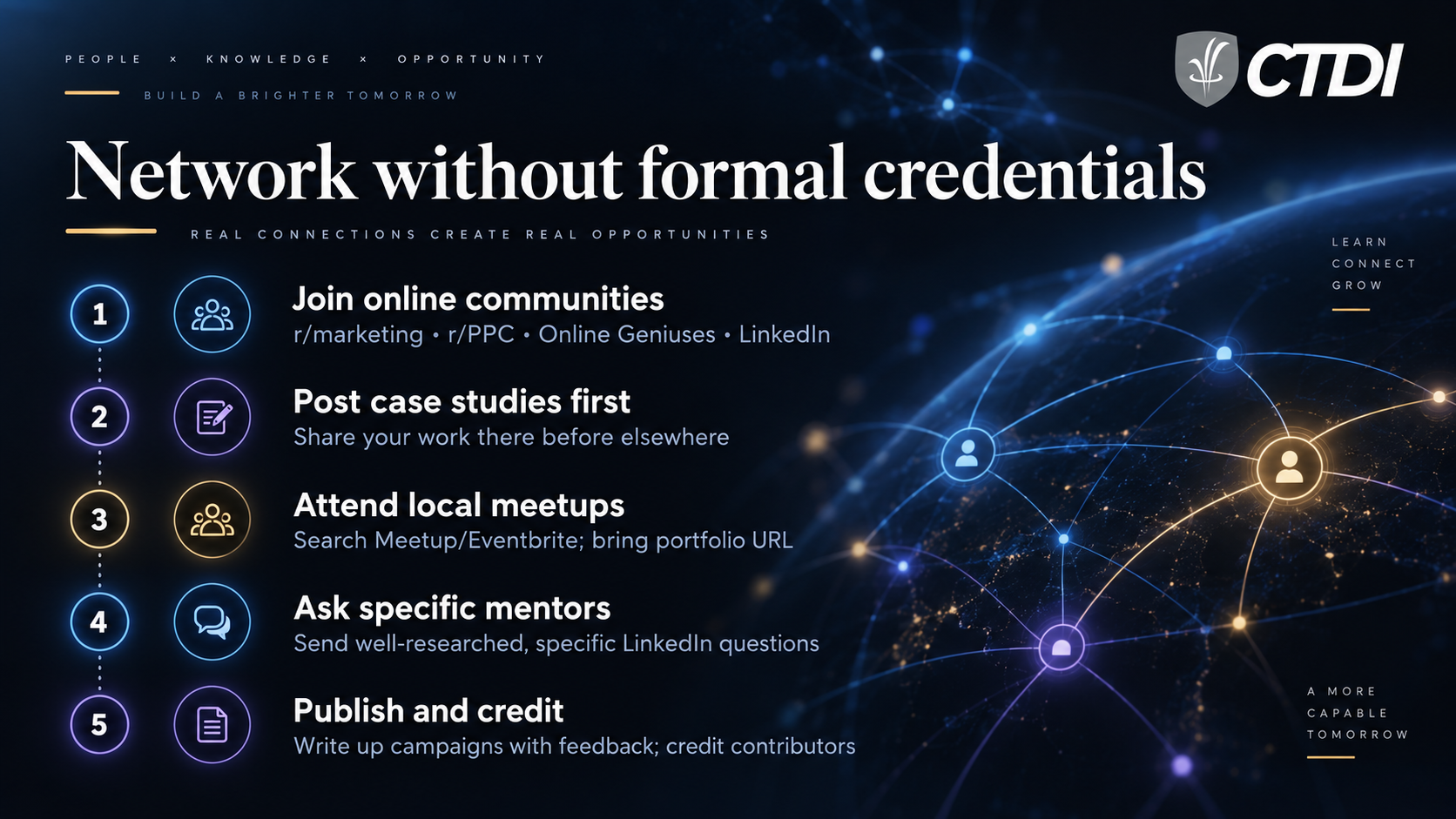
Instead of asking someone to “help you get into marketing”, participate in professional communities, attend events or webinars and share work you are already developing. Specific questions tend to create better conversations than generic requests for career advice. Over time, the work you publish and the discussions you contribute to can become part of your professional identity.
Keep building, applying and improving
Starting digital marketing without a university degree is possible, but career development is rarely about finding one shortcut.
A stronger approach is to keep moving through a simple cycle: Learn → Apply → Measure → Reflect → Improve
Build your foundations, choose an area to practise, create work you can explain. Identify your skills gaps, then decide whether self-directed learning, short courses or a nationally recognised qualification best supports your next step.
For professionals looking for a structured pathway, CTDI’s 11266NAT Advanced Diploma of Digital Marketing offers flexible, fully online study across digital strategy, analytics, content, search, advertising, email marketing and responsible AI.
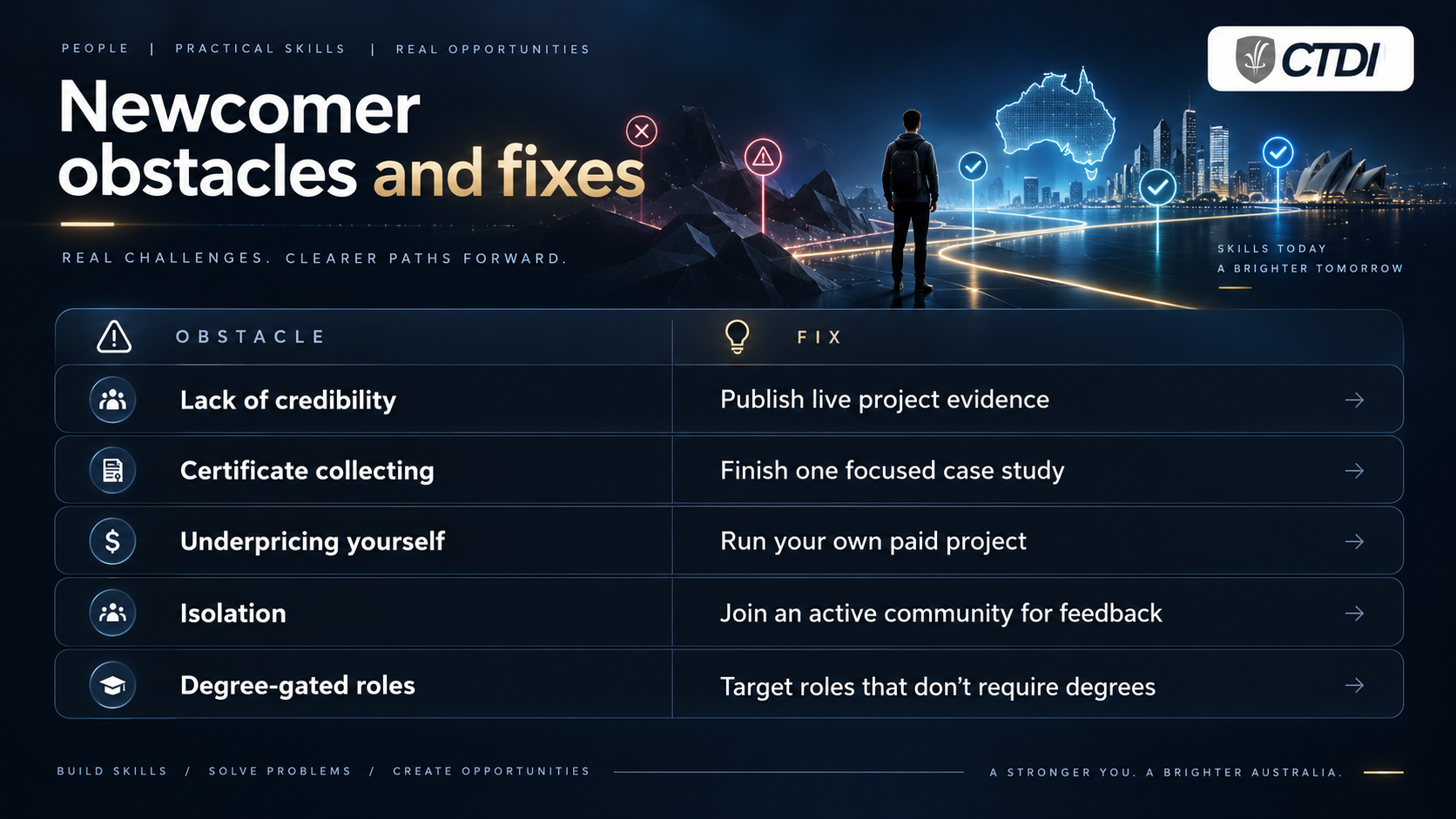
The goal is not simply to collect another credential. It is to keep building the practical skills, knowledge and confidence you can carry into your next career opportunity.
Disclaimer: This article provides general information only. Course requirements, study pathways and career outcomes may vary. Always confirm current requirements with the relevant education provider or authority.